


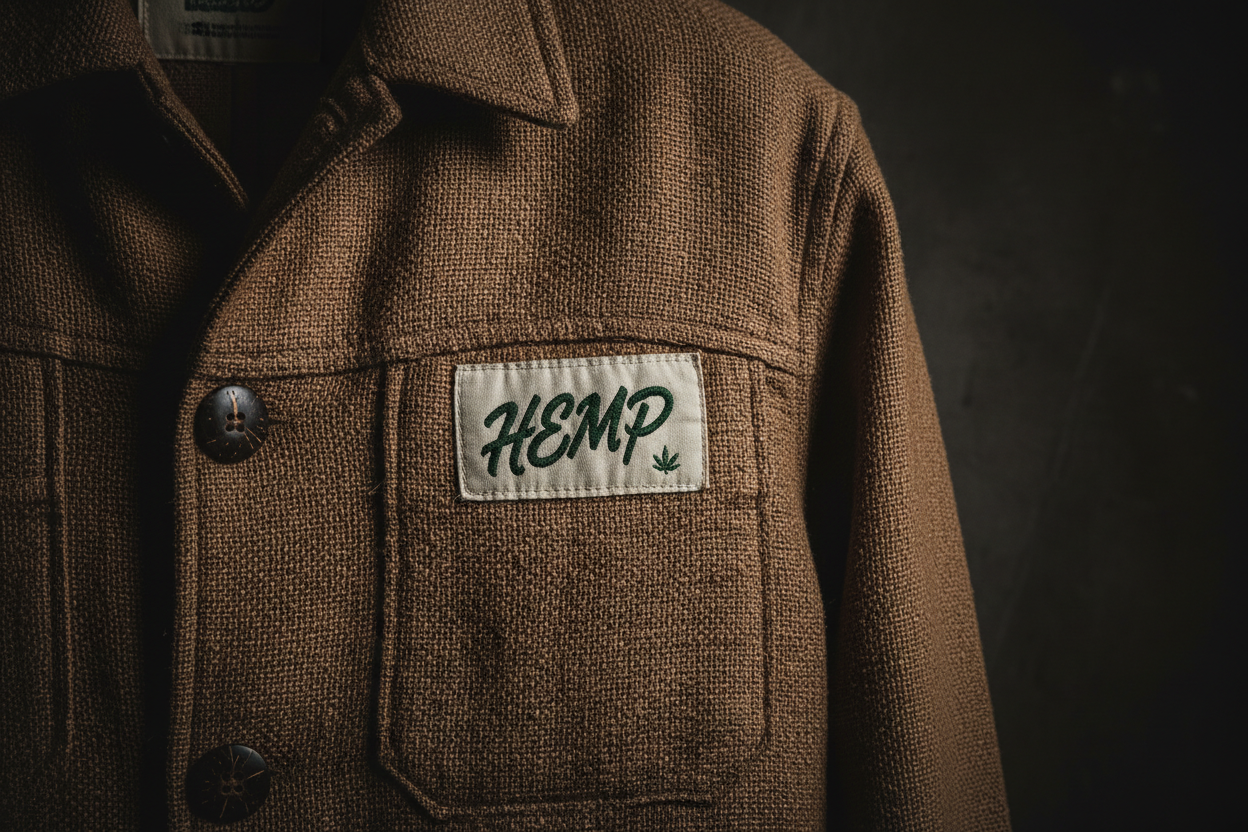
You've seen a hemp jacket priced at ₹8000 or ₹12000 and paused. Next to a Zara or Mango alternative at ₹2,500, the difference feels hard to justify — especially when both are, at first glance, just jackets.
This is a fair question, and it deserves a straight answer. Not a lecture on sustainability, not a guilt trip about fast fashion — just an honest account of where the money actually goes when you buy a hemp garment, and why the gap in price is not arbitrary.
The short version: hemp clothing costs more because it is priced closer to what it actually costs to make. The cheaper alternative isn't cheaper because someone found a smarter way to produce it. It's cheaper because many of its real costs — environmental, social, health-related — have been quietly passed on to someone else.
Here's the longer version.
Start with the fabric itself
Cotton is one of the most industrially optimised crops in the world. It has been grown at massive scale for over a century, subsidised by governments across the US, China, and India, engineered for mechanical harvesting, and processed through infrastructure built over generations. The global cotton system is extraordinarily efficient at producing cheap fibre — and that efficiency is built into every ₹800 cotton shirt you've ever bought.
Hemp exists entirely outside that system. It's grown by fewer farmers, processed through smaller mills, and supported by almost no government subsidy or commodity infrastructure. The crop itself is actually less demanding than cotton — it needs around half the water, no pesticides, and it improves rather than degrades the soil it grows in. But 'less demanding to grow' doesn't automatically mean 'cheaper to buy', because price is set by markets, not by ecology. And the market for hemp fibre is small, fragmented, and young.
The result is that raw hemp fibre — before it has been spun into yarn or woven into fabric — costs significantly more per kilogram than cotton. Not because it is scarcer in any natural sense, but because the industrial infrastructure to produce it at scale doesn't yet exist. You are, in part, paying for a supply chain that is still being built.
Hemp needs half the water cotton does and improves the soil it grows in. But 'less demanding to grow' doesn't mean 'cheaper to buy' — price is set by markets, not by ecology.
Processing is where the cost really separates
Cotton fibre, once the seed is removed, is essentially ready to spin. Modern cotton mills process thousands of kilograms per hour with minimal human intervention. The machinery is mature, the processes are standardised, and the labour input per kilogram of finished yarn is extremely low.
Hemp is different. The usable fibre is locked inside the plant's woody stem, and releasing it requires a sequence of steps that cotton simply doesn't need. First, retting — the stalks are soaked or laid in fields for days or weeks to allow microbial action to loosen the fibres. Then drying, scutching to separate the fibre from the woody core, and hackling to comb and align the fibres for spinning. Each of these steps takes time, space, and skilled attention. Partial mechanisation exists, but hemp processing remains substantially more labour-intensive than cotton at every stage.
By the time hemp emerges as spinnable fibre, it has passed through more hands and more processes than cotton of comparable weight. That shows up in price. Hemp yarn typically costs two to four times more than cotton yarn of equivalent weight, and that differential carries through every subsequent step of production.
Weaving, dyeing, and the mill reality
Hemp fabric is harder to work with than cotton at the mill level. The fibres are stiffer and less uniform, which means slower spinning speeds, higher yarn breakage rates, and more quality control at every stage. Dyeing is more complex too — natural fibres absorb dye unevenly compared to synthetic alternatives, and achieving consistent colour across a batch requires more careful process management.
Mills that work with hemp typically operate at smaller scale than cotton mills, which means they can't spread their fixed costs across the same volume. Minimum order quantities per metre are higher relative to output, setup costs are harder to amortise, and the knowledge required to work the fabric well is genuinely specialist. All of this translates into a higher cost per metre of finished fabric before a single cut has been made.
Outerwear amplifies every cost upstream
A hemp t-shirt carries all of the fabric cost differentials described above. A hemp jacket carries all of those, plus the additional complexity of outerwear construction.
Jackets involve multiple fabric panels, structural reinforcements, interlining, hardware — buttons, snaps, zips — and significantly more skilled sewing time than a shirt. Hemp canvas is tough on machinery: it wears needles faster, requires slower stitch speeds to maintain seam quality, and has a higher rejection rate during quality control because the fabric's texture makes imperfections more visible. All of this increases the time and skill cost per garment.
A reasonable quality cotton jacket from a mid-sized manufacturer might take 45 minutes of skilled labour to produce. A comparable hemp canvas jacket, made carefully, takes longer — and at every step, the material cost it's being sewn from is also higher. The price difference between the two at retail is not padding. It's arithmetic.
A reasonable quality cotton jacket might take 45 minutes of skilled labour to produce. A hemp canvas jacket, made carefully, takes longer — and the material cost at every step is also higher. The price difference is not padding. It's arithmetic.
Small batches make everything more expensive
Fast fashion brands price their products the way they do partly because of the volumes they move. When you produce 50,000 units of a jacket, you negotiate raw material costs down to their floor, your per-unit cutting waste becomes negligible, your machinery runs at maximum efficiency, and your logistics costs per unit are minimal. The economics of scale are real and powerful.
Small-batch sustainable brands produce hundreds of units, not tens of thousands. There are no bulk discounts on fabric. Cutting waste per unit is higher. Every metre of fabric ordered comes with a minimum quantity that a small brand struggles to fully utilise. The negotiating power with mills and suppliers is limited. These are not inefficiencies — they are the structural reality of making things in small quantities, which is itself part of what makes slow fashion slow.
This is worth being direct about: some of what you pay for in a small-batch hemp jacket is the fact that it wasn't made in a factory running three shifts a day producing 2,000 identical units a week. Whether that's worth something to you is a genuine question, not a rhetorical one.

Unfortunately, the recent policy decisions around GST on apparel tend to exacerbate things further - we will cover this as a separate critique in another blog article.
What the cheaper jacket is not paying for
The most important part of understanding hemp pricing isn't the supply chain of hemp — it's understanding what's missing from the supply chain of the alternative.
A ₹1,500 polyester jacket is cheap because polyester is derived from petroleum and manufactured at extraordinary industrial scale with minimal labour input. It is also cheap because the environmental costs of its production — carbon emissions, water pollution, microplastic contamination — are not included in its price. They are externalised: distributed across the atmosphere, waterways, and the bodies of people who live near synthetic textile manufacturing facilities.
The same is true, to a lesser degree, of cheap cotton. Conventional cotton farming is one of the most pesticide-intensive forms of agriculture in the world. The health costs of that pesticide use fall on farmworkers and farming communities, not on the supply chain accounting that produces the retail price. The water depletion is borne by local ecosystems and future users of those aquifers, not by the brand selling the shirt.
Hemp pricing internalises more of its actual costs. The farming is cleaner, so there are fewer costs being quietly passed to someone else. The processing is more labour-intensive, so workers are paid for more of the real work involved. The result is a higher sticker price and a lower hidden cost — which is a different way of distributing the same total expense, not a more expensive product in any meaningful sense.
A cheaper jacket isn't cheaper because someone found a smarter way to make it. It's cheaper because many of its real costs — environmental, social, health-related — have been quietly passed on to someone else.
So - is it worth it?
That depends on what you're asking the jacket to do.
If you want something to wear for a season or two and replace, hemp is probably not the right choice. The price premium doesn't make sense for that use case, and there are reasonable cotton options that will serve you well for a short period without costing much.
If you want something that improves with wear, lasts for years, is made from a fabric that's genuinely better for the environment, and whose price reflects what it actually cost to produce rather than what could be got away with charging — then hemp is exactly what it sounds like: a more honest product at a more honest price.
You're not paying for a logo. You're paying for time, labour, restraint, and a material that refuses to be rushed. That's what the price means.
At The Rugged Soul, we make two hemp jacket styles — both using hemp-cotton blends, both produced in small batches, and both priced to reflect what they actually cost to make rather than what the market might bear.
The Hemp Canvas Trucker is our heavier option: 70% hemp, 30% cotton at 260 GSM, structured and textured, with a break-in period that results in a jacket that fits only you. The Hemp Bomber is lighter: 55% hemp, 45% cotton at 165 GSM, softer and immediately comfortable from first wear.
Both are lined with soft cotton-flax, free from synthetic coatings, and built to last considerably longer than their price tag might suggest if you're used to fast-fashion comparisons.
Share:
Fabric Science: Breathability and Durability
Understanding Hemp: Why This Ancient Fibre Deserves a Place in Your Wardrobe